INPUT
At the real-time level, classical decoders and control systems must react to quantum hardware quickly enough to keep a logical computation operating. The AWS report describes this as a setting where low-latency coupling can be essential.
AMAZON WEB SERVICES
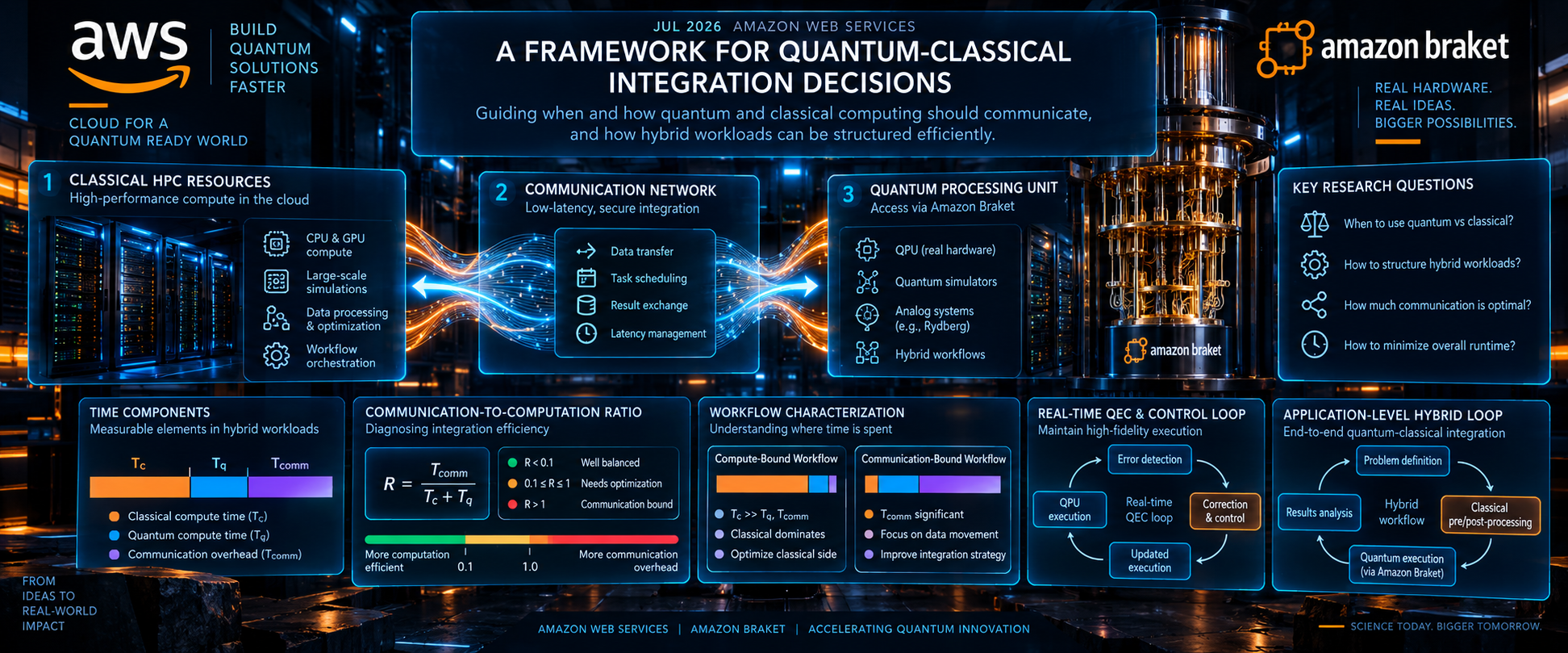
AWS, Lawrence Berkeley National Laboratory, NASA and NVIDIA develop a performance model for deciding when tightly integrated quantum-classical infrastructure is useful for hybrid workloads.
THE IDEA
Quantum processors do not operate independently of classical computers. Control systems, calibration, decoding and hybrid algorithms all require classical computation.
The research separates two levels of quantum-classical integration: real-time control and error correction, where latency can be critical, and application-level hybrid algorithms, where the communication requirement depends on the workload.
This distinction matters because a fast physical connection is not automatically valuable for every quantum algorithm.
TWO LEVELS
At the real-time level, classical decoders and control systems must react to quantum hardware quickly enough to keep a logical computation operating. The AWS report describes this as a setting where low-latency coupling can be essential.
At the application level, workflows such as variational algorithms repeatedly exchange information between a classical host and a quantum processing unit.
The communication requirements of those two layers should therefore be evaluated separately rather than treating quantum-classical integration as a single engineering problem.
At the real-time level, classical decoders and control systems must react to quantum hardware quickly enough to keep a logical computation operating. The AWS report describes this as a setting where low-latency coupling can be essential.
At the application level, workflows such as variational algorithms repeatedly exchange information between a classical host and a quantum processing unit.
The communication requirements of those two layers should therefore be evaluated separately rather than treating quantum-classical integration as a single engineering problem.
THE MODEL
The framework decomposes a hybrid cycle into classical compute time, quantum compute time and communication overhead.
The ratio Rcc compares communication time with total classical and quantum computation time. When the ratio is small, communication contributes relatively little to the cycle; when it is large, communication can dominate.
This provides a quantitative way to reason about whether co-locating quantum and classical resources is likely to matter for a given workload.
The framework decomposes a hybrid cycle into classical compute time, quantum compute time and communication overhead.
The ratio Rcc compares communication time with total classical and quantum computation time. When the ratio is small, communication contributes relatively little to the cycle; when it is large, communication can dominate.
This provides a quantitative way to reason about whether co-locating quantum and classical resources is likely to matter for a given workload.
RESULTS
The framework does not claim that all current hybrid algorithms require tightly coupled infrastructure. Instead, it identifies workload-dependent crossover conditions.
The analysis points to future developments that could change the answer, including major reductions in measurement budgets through techniques such as amplitude estimation and the emergence of practical quantum memory.
The model therefore acts as an infrastructure-planning tool: as algorithms and hardware change, the integration decision can be reevaluated using measurable workload parameters.
WHERE IT COULD MATTER
Fault-tolerant quantum computing will require tight classical control and error-correction loops, making latency a fundamental systems concern.
HPC centers can use the model when evaluating whether QPUs should be closely integrated with classical supercomputing resources for particular application workloads.
Cloud providers and quantum application developers can also use communication-to-computation analysis when designing execution architectures.
QCAASNET TAKEAWAY
The paper's central contribution is a way to make quantum-classical infrastructure decisions quantitative rather than purely architectural.
Real-time control and application-level hybrid algorithms have different latency requirements, and they should be analyzed separately.
As quantum algorithms evolve, the same framework can be reused to determine when tighter integration becomes computationally meaningful.
This research should be read in the context of current quantum hardware and hybrid computing constraints. The results described here are research demonstrations, models or workflows rather than evidence that quantum processors have already replaced classical methods for general-purpose workloads.
ORIGINAL RESEARCH
Trenev et al., A framework for quantum-classical integration decisions, arXiv:2607.15426 (2026).