INPUT
Large combinatorial optimization problems can become difficult because the number of possible configurations grows rapidly with problem size. The collaboration therefore studies decomposition methods that expose smaller subproblems.
AMAZON WEB SERVICES
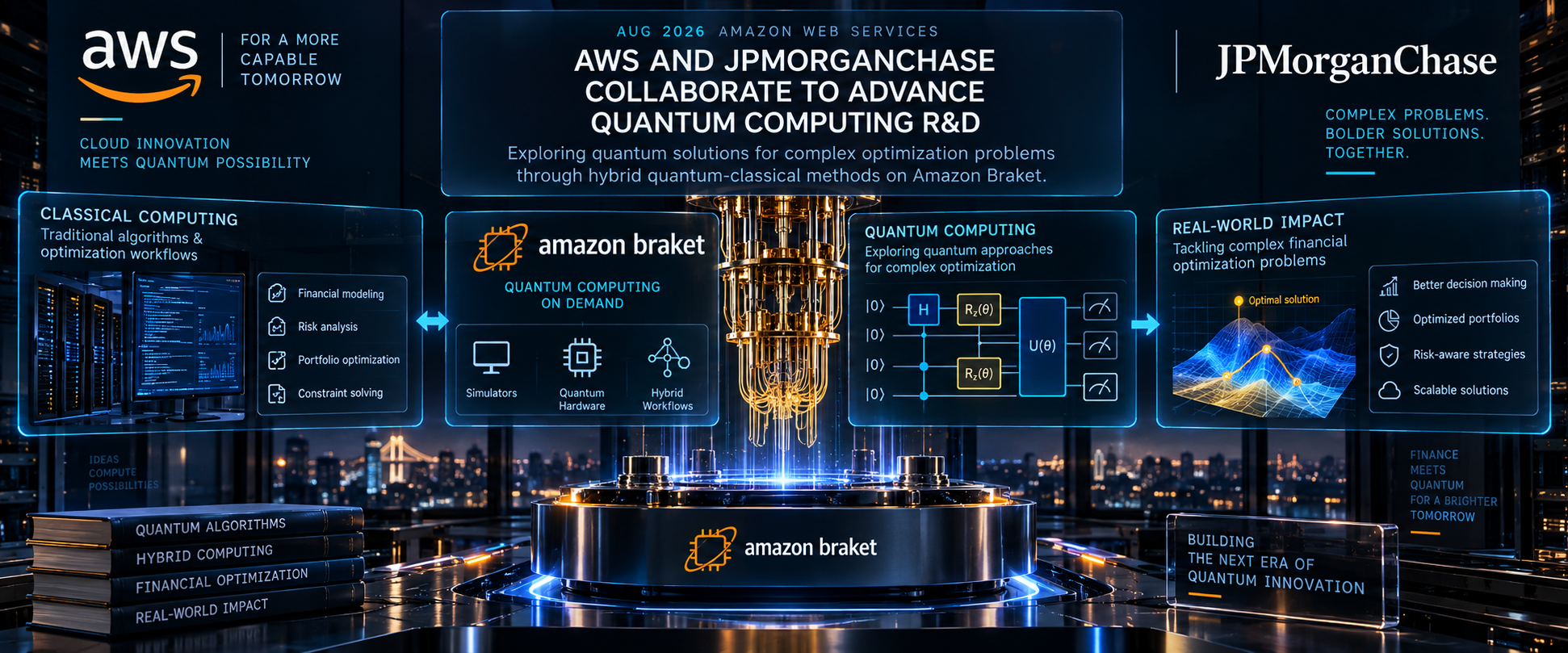
A research collaboration exploring how quantum and classical resources can work together on large-scale optimization problems, with experiments using quantum devices available through Amazon Braket.
THE IDEA
AWS and JPMorganChase describe a sustained research program focused on complex optimization problems in finance and beyond. The work combines quantum algorithms, classical optimization and experiments on quantum devices accessed through Amazon Braket.
Rather than treating the quantum processor as a replacement for classical optimization software, the collaboration investigates how a quantum device can act as a co-processor inside a larger workflow.
The August 2026 AWS report brings together several research results into a toolkit for working with large optimization problems on near-term Rydberg quantum hardware.
DECOMPOSITION
Large combinatorial optimization problems can become difficult because the number of possible configurations grows rapidly with problem size. The collaboration therefore studies decomposition methods that expose smaller subproblems.
For portfolio optimization, the published decomposition pipeline preprocesses correlation information, partitions the problem into subproblems, solves those subproblems and then aggregates the results while checking feasibility.
The research reports that the decomposition can reduce the size of subproblems substantially, creating instances that are more compatible with available classical solvers and near-term quantum hardware.
Large combinatorial optimization problems can become difficult because the number of possible configurations grows rapidly with problem size. The collaboration therefore studies decomposition methods that expose smaller subproblems.
For portfolio optimization, the published decomposition pipeline preprocesses correlation information, partitions the problem into subproblems, solves those subproblems and then aggregates the results while checking feasibility.
The research reports that the decomposition can reduce the size of subproblems substantially, creating instances that are more compatible with available classical solvers and near-term quantum hardware.
HYBRID WORKFLOW
The collaboration tests quantum devices alongside advanced classical solvers rather than in isolation. This allows the classical side to perform tasks such as preprocessing, reduction and post-processing while quantum hardware is used on selected computational components.
The AWS report also discusses Rydberg-atom platforms as a natural setting for certain graph-optimization problems. The objective is to identify problem structures for which near-term quantum hardware can contribute useful information.
The resulting workflow is therefore hybrid by design: the value comes from the interaction between classical algorithms, problem structure and quantum experiments.
The collaboration tests quantum devices alongside advanced classical solvers rather than in isolation. This allows the classical side to perform tasks such as preprocessing, reduction and post-processing while quantum hardware is used on selected computational components.
The AWS report also discusses Rydberg-atom platforms as a natural setting for certain graph-optimization problems. The objective is to identify problem structures for which near-term quantum hardware can contribute useful information.
The resulting workflow is therefore hybrid by design: the value comes from the interaction between classical algorithms, problem structure and quantum experiments.
RESULTS
The August 2026 report presents three additional research directions as a combined toolkit: decomposition for portfolio optimization, compilation techniques for Rydberg atom arrays, and quantum-informed reduction for maximum independent set problems.
The work demonstrates that problem reduction can make large instances more tractable and can also expose smaller subproblems that are better matched to currently available quantum devices.
These results are research demonstrations rather than a claim that current quantum hardware has replaced classical optimization for production-scale finance.
WHERE IT COULD MATTER
Portfolio optimization and rebalancing are direct examples because they contain large constrained combinatorial structures.
The same general strategy can apply to transportation, logistics, telecommunications, manufacturing and other domains where graph or discrete optimization problems arise.
The broader idea is to design the classical reduction layer and quantum computation layer together, rather than optimizing either component independently.
QCAASNET TAKEAWAY
The important idea is the architecture of the workflow: classical and quantum computation are deliberately combined rather than treated as competing approaches.
Amazon Braket provides access to quantum devices that can be incorporated into these experiments, while the classical side handles decomposition, reduction and validation.
The research is best understood as a study of where quantum co-processing can fit into difficult optimization workflows, not as a demonstration of universal quantum advantage.
This research should be read in the context of current quantum hardware and hybrid computing constraints. The results described here are research demonstrations, models or workflows rather than evidence that quantum processors have already replaced classical methods for general-purpose workloads.
ORIGINAL RESEARCH
AWS Quantum Technologies Blog — AWS and JPMorganChase collaborate to advance quantum computing R&D.