INPUT
A full open-system simulation evolves a density matrix rather than a simple state vector. For n qubits, a dense density matrix contains O(4ⁿ) elements.
AMAZON WEB SERVICES
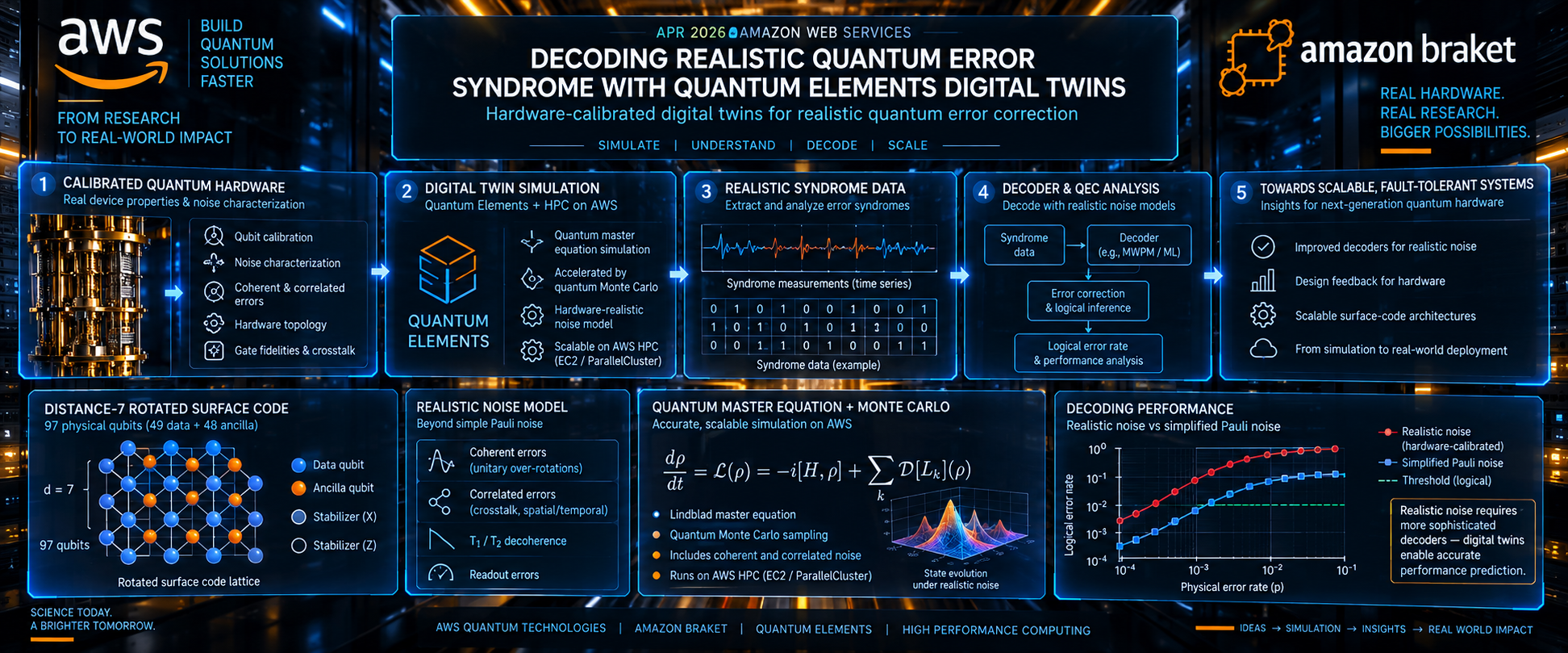
AWS and collaborators use hardware-calibrated digital twins and quantum Monte Carlo methods to simulate realistic surface-code noise at an experiment-relevant scale.
THE IDEA
Fault-tolerant quantum computing depends on quantum error correction, but realistic error models are difficult to simulate. Simplified Pauli or stabilizer models can miss coherent and correlated effects present in real hardware.
A hardware-calibrated digital twin attempts to reproduce the behavior of a real device closely enough that simulated syndrome data can be used to study decoders and error-correction strategies.
The April 2026 work combines such a digital-twin approach with classical high-performance computing.
THE CHALLENGE
A full open-system simulation evolves a density matrix rather than a simple state vector. For n qubits, a dense density matrix contains O(4ⁿ) elements.
That exponential growth makes straightforward master-equation simulation impractical as the number of physical qubits increases.
The research therefore uses a real-time quantum Monte Carlo method that represents the evolution stochastically using a population of walkers.
A full open-system simulation evolves a density matrix rather than a simple state vector. For n qubits, a dense density matrix contains O(4ⁿ) elements.
That exponential growth makes straightforward master-equation simulation impractical as the number of physical qubits increases.
The research therefore uses a real-time quantum Monte Carlo method that represents the evolution stochastically using a population of walkers.
QEC MODEL
As an experiment-scale demonstration, the team simulated a single syndrome-extraction round of a distance-7 rotated surface code containing 97 physical qubits: 49 data qubits and 48 measurement qubits.
The simulation was designed to retain realistic coherent and correlated noise mechanisms instead of replacing the device with an idealized error model.
The workflow used Amazon EC2 HPC resources and AWS ParallelCluster to distribute the computational workload.
As an experiment-scale demonstration, the team simulated a single syndrome-extraction round of a distance-7 rotated surface code containing 97 physical qubits: 49 data qubits and 48 measurement qubits.
The simulation was designed to retain realistic coherent and correlated noise mechanisms instead of replacing the device with an idealized error model.
The workflow used Amazon EC2 HPC resources and AWS ParallelCluster to distribute the computational workload.
RESULTS
The AWS report states that the 97-qubit simulation could be run in about an hour on a single compute node using the QMC-accelerated master-equation approach.
Because the method can generate realistic syndrome data, it can support the development and evaluation of more expressive decoders, including neural-network-based approaches.
The digital twin also creates a feedback loop between calibration, circuit design, decoder development and hardware architecture.
WHERE IT COULD MATTER
Hardware-faithful QEC simulation can help researchers stress-test decoders against error mechanisms that are difficult to isolate experimentally.
It can support co-design decisions involving calibration, layout, syndrome-extraction circuits and logical-qubit architecture.
The longer-term goal is to make realistic simulation efficient enough to run repeatedly as part of the engineering workflow for fault-tolerant quantum systems.
QCAASNET TAKEAWAY
The important contribution is not a new quantum error-correcting code; it is a more realistic computational environment for studying how existing and future QEC systems behave on hardware.
Digital twins connect calibrated hardware behavior with scalable classical simulation, producing syndrome data that can be used to develop and test decoders.
The demonstrated 97-qubit scale is a simulation milestone rather than a full fault-tolerant quantum computer, but it addresses a practical engineering bottleneck.
This research should be read in the context of current quantum hardware and hybrid computing constraints. The results described here are research demonstrations, models or workflows rather than evidence that quantum processors have already replaced classical methods for general-purpose workloads.
ORIGINAL RESEARCH
AWS Quantum Technologies Blog — Decoding Realistic Quantum Error Syndrome with Quantum Elements Digital Twins.