INPUT
Consider an observable composed of multiple measurement terms. If one term contributes little to the final result or has low variance, spending a large fraction of the shot budget on it may be inefficient.
AMAZON WEB SERVICES
Amazon Braket researchers show how adaptive measurement allocation can reduce estimation error for a fixed shot budget and provide an educational implementation for quantum algorithm developers.
THE IDEA
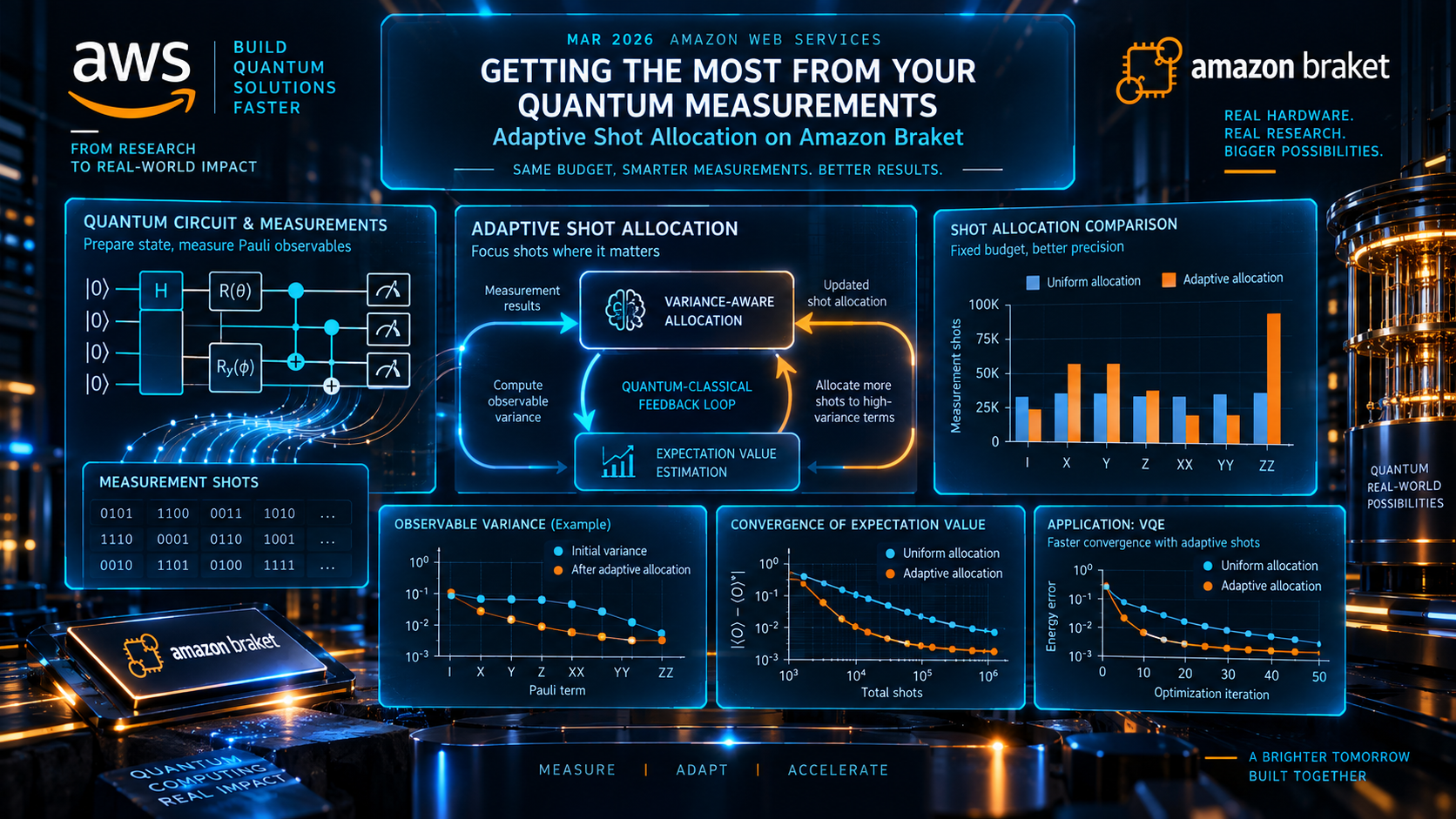
Variational quantum algorithms repeatedly estimate expectation values from measurements. Each circuit execution consumes a finite number of shots, so the measurement budget itself becomes a resource.
A simple strategy gives every observable term the same number of shots. But different terms can have different weights and variances, so equal allocation does not necessarily minimize the final estimator error.
Adaptive allocation instead uses information gathered during the experiment to decide where subsequent shots should be spent.
MEASUREMENT
Consider an observable composed of multiple measurement terms. If one term contributes little to the final result or has low variance, spending a large fraction of the shot budget on it may be inefficient.
Adaptive allocation estimates the behavior of individual terms and reallocates later measurements toward terms that have a greater influence on the uncertainty of the final quantity.
The AWS implementation is based on earlier research on adaptive estimation of quantum observables and is intended as an educational and exploratory starting point.
Consider an observable composed of multiple measurement terms. If one term contributes little to the final result or has low variance, spending a large fraction of the shot budget on it may be inefficient.
Adaptive allocation estimates the behavior of individual terms and reallocates later measurements toward terms that have a greater influence on the uncertainty of the final quantity.
The AWS implementation is based on earlier research on adaptive estimation of quantum observables and is intended as an educational and exploratory starting point.
AMAZON BRAKET
AWS released an implementation in the Amazon Braket Algorithms Library together with two notebooks: an introduction to shot allocation and a hands-on adaptive shot-allocation walkthrough.
The implementation demonstrates grouping observable terms, estimating term variance, allocating additional shots and tracking convergence.
The goal is not to present the module as a production-optimized library component, but to make the underlying strategy easier to test and adapt.
AWS released an implementation in the Amazon Braket Algorithms Library together with two notebooks: an introduction to shot allocation and a hands-on adaptive shot-allocation walkthrough.
The implementation demonstrates grouping observable terms, estimating term variance, allocating additional shots and tracking convergence.
The goal is not to present the module as a production-optimized library component, but to make the underlying strategy easier to test and adapt.
RESULTS
The AWS post reports a representative example using a 26-term Hamiltonian for a small molecule. In that example, adaptive allocation reduced estimation error by approximately 40 percent compared with uniform allocation for the same total shot count.
The improvement comes with a tradeoff: adaptive strategies typically require multiple rounds of circuit execution and classical processing.
The result therefore illustrates an important systems principle: reducing quantum measurement cost can increase classical orchestration and wall-clock overhead.
WHERE IT COULD MATTER
Measurement allocation is directly relevant to VQE and other variational algorithms that repeatedly estimate expectation values.
It can also matter for benchmarking, quantum chemistry experiments and workflows where QPU access is limited or expensive.
The broader lesson is that algorithm performance depends not only on the quantum circuit but also on how measurement resources are scheduled around it.
QCAASNET TAKEAWAY
Shots are a computational resource, and the same total number of measurements can produce different estimator quality depending on how those shots are allocated.
Adaptive allocation uses intermediate measurement information to concentrate resources where they matter most.
The technique does not eliminate the classical overhead of adaptive control; instead, it trades additional orchestration for potentially lower estimation error at the same quantum shot budget.
This research should be read in the context of current quantum hardware and hybrid computing constraints. The results described here are research demonstrations, models or workflows rather than evidence that quantum processors have already replaced classical methods for general-purpose workloads.
ORIGINAL RESEARCH
Shlosberg et al., Adaptive estimation of quantum observables, Quantum (2023).