Classical copy
A classical message can be duplicated before it is used, so one delivery can serve many compatible computations.
GOOGLE QUANTUM AI
A research paper asks whether useful data can be sent as a quantum state, used for a computation, and then become genuinely harder to reuse.
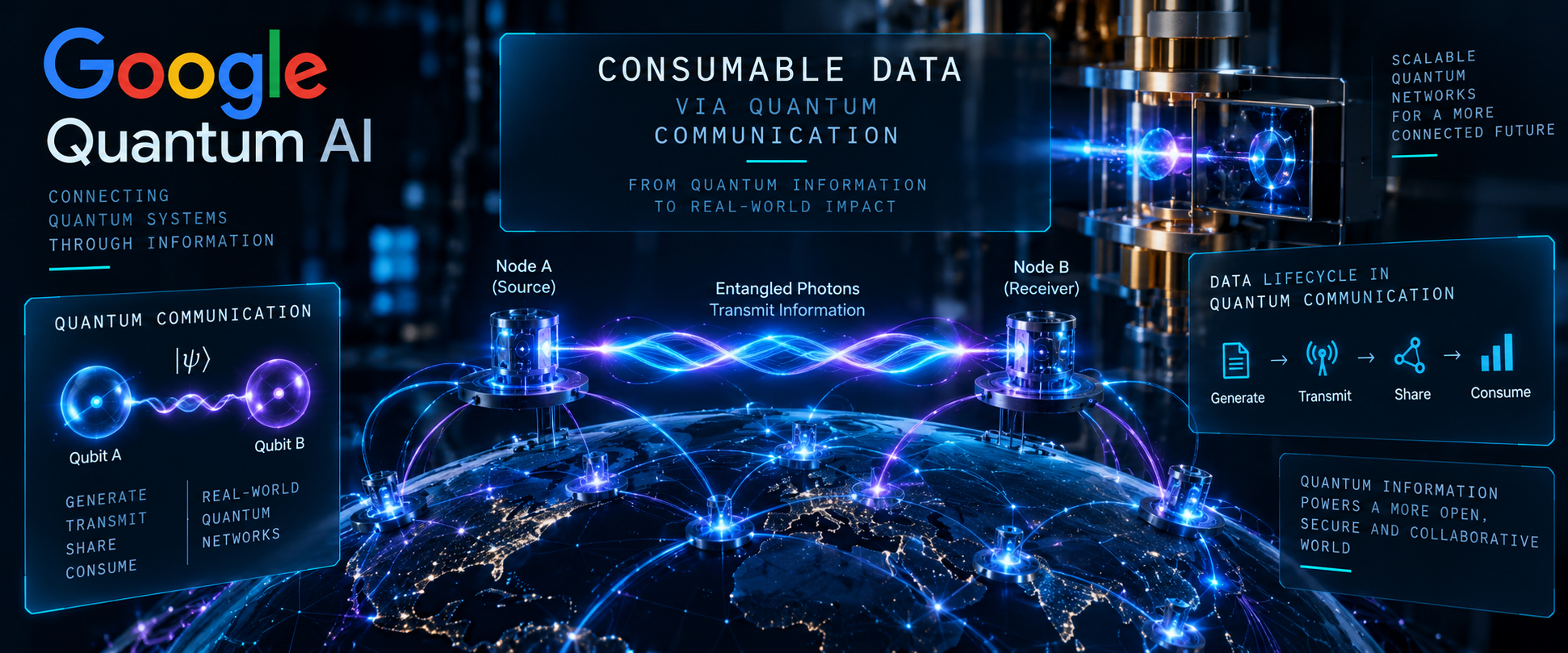
THE QUESTION
Classical information is easy to copy. Once a buyer receives an ordinary data file, the same file can usually support many later computations at almost no extra cost. That makes data economically different from physical inputs such as fuel or raw materials.
This paper studies a narrower, information-theoretic possibility. Alice holds data and sends Bob a quantum message that helps solve a task. If using that message for one task makes it costly to solve many more tasks, the data behaves like a consumable resource.
A classical message can be duplicated before it is used, so one delivery can serve many compatible computations.
Measuring a quantum state can disturb it. That physical constraint can make reuse expensive for particular tasks.
No-cloning alone is not enough. The state must be both useful for the task and hard to reuse in the stated communication model.
THE PAPER'S TEST
The authors formalize an asymmetric direct-sum question. Alice keeps one input, while Bob holds m different inputs and wants an answer for every pairing. A problem is called consumable when the communication needed for those m uses grows polynomially relative to a single use.
Why this matters The framework measures the cost of communication from Alice to Bob, not an all-purpose guarantee that quantum data cannot be copied or shared.
THREE EXAMPLES
Alice's quantum state can reveal one matching-related answer. For multiple hidden matchings, the paper proves a lower bound that grows as Ω(√m) for the stated parameter range.
For a sampling version of linear regression, the paper shows a setting where quantum communication grows essentially linearly with the number of requested samples, while classical communication can be reused.
When multiple Bobs are limited to single-copy measurements and classical communication between themselves, estimating many observables can require a number of copies that grows nearly linearly with the number of observables.
NOT AUTOMATIC
The paper also identifies a limit. In some decision problems, a receiver can use shadow tomography to estimate the answers to many two-outcome measurements from a number of copies that grows only polylogarithmically with the number of measurements.
The lesson is subtle: the task, the number of possible outputs, the allowed measurements, and whether recipients can exchange quantum information all affect whether the data is consumable.
ECONOMIC INTERPRETATION
Classical data is commonly treated as non-rival: one buyer's use does not stop another use, because copying is cheap. The paper argues that, in specific quantum communication settings, a useful state can instead behave more like a rival input. More uses require more communication.
This is a theoretical result, not a ready-made data-market product. The paper's conclusions depend on the selected tasks and communication restrictions, and it discusses these constraints explicitly.
QCAASNET TAKEAWAY
Quantum data is not universally one-time-use. The relevant question is whether it can support many instances of a particular computation.
Allowing multi-copy measurements or quantum communication between recipients can fundamentally change the resource cost.
The work uses destructive measurement as a bridge between quantum information theory and the value of data in a market.
ORIGINAL RESEARCH
Dar Gilboa, Siddhartha Jain, and Jarrod R. McClean. Google Quantum AI and UT Austin.
arXiv:2409.08495v3 · July 2025 · CC BY 4.0