Physical drift
Control frequencies, amplitudes and phases can change over time, moving the processor away from its calibrated operating point.
GOOGLE QUANTUM AI
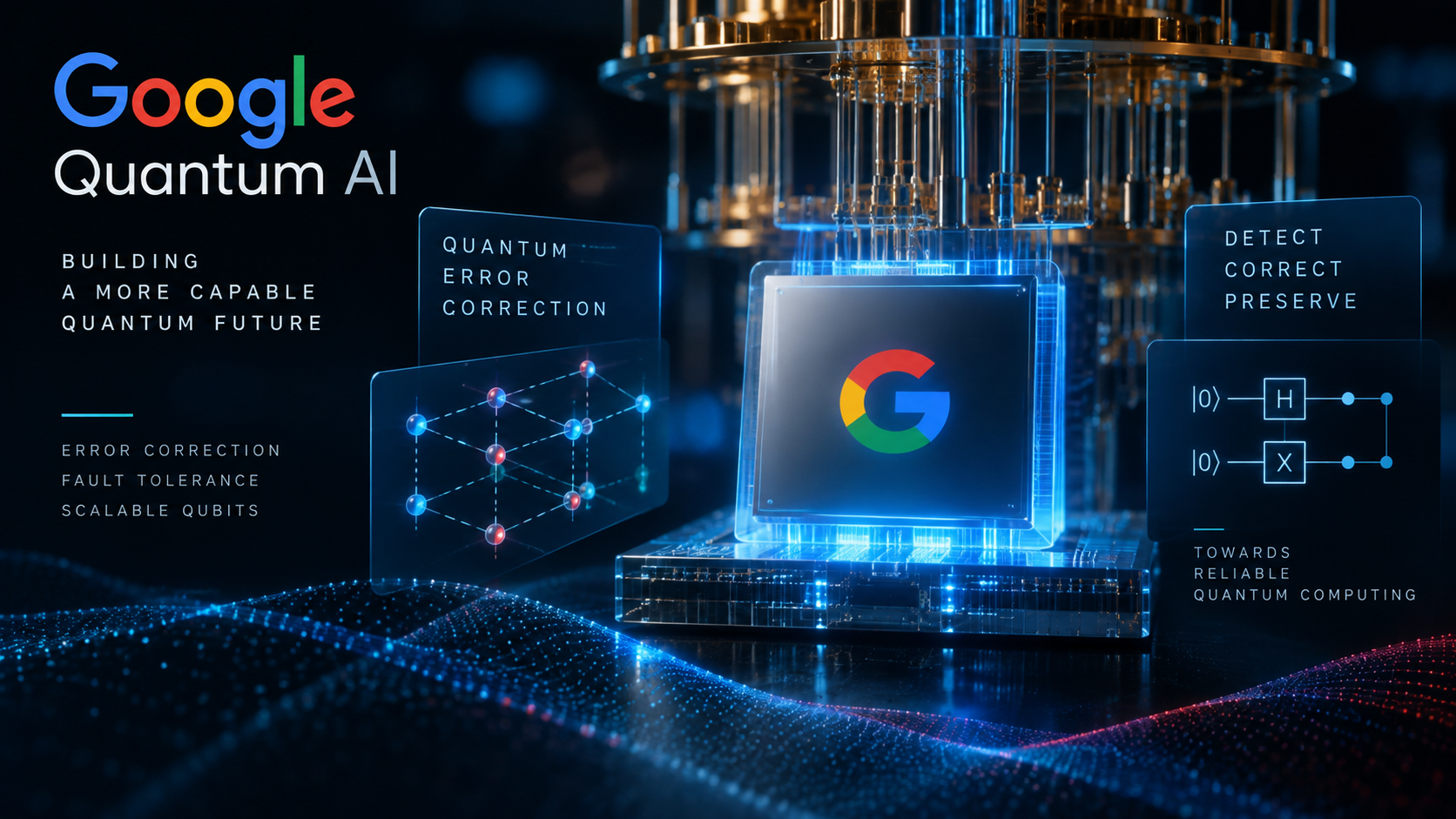
A new approach combines reinforcement learning with quantum error correction so a quantum processor can continuously adapt to control drift instead of stopping computation for recalibration.
THE IDEA
Quantum computers are extremely sensitive to changes in their environment and in the analog control signals used to operate their qubits. Frequencies, amplitudes and phases can drift over time, changing how accurately the processor performs its operations.
Today, dealing with this drift can require stopping a quantum computation and recalibrating the processor. That creates a fundamental problem for future workloads that may need to run continuously for days or months.
The Google Quantum AI team explored a different idea: use the information already produced by quantum error correction as a learning signal for a reinforcement learning agent.
Instead of using error-detection events only to identify and correct logical errors, the framework also uses them to learn how the processor is drifting and continuously adjust its control parameters.
The result is a feedback loop in which the quantum computer can respond to changing conditions while computation continues.
THE PROBLEM
A useful quantum processor has to maintain accurate control over many physical parameters. Because the machine is fundamentally analog, those parameters can drift as the environment and hardware conditions change.
This is different from the behavior expected from ordinary digital computers. A classical processor does not normally require its logic gates to be continuously retuned while a program is executing.
Quantum error correction helps by encoding logical information across multiple physical qubits and repeatedly checking for signatures of errors. But error correction does not automatically explain why the errors occurred.
Control frequencies, amplitudes and phases can change over time, moving the processor away from its calibrated operating point.
QEC produces detection events that indicate that an error occurred within a relevant spacetime region.
The detection data can correct logical information, but it can also reveal patterns caused by imperfect control and hardware drift.
The research asks whether those same detection events can become an additional feedback channel for quantum control.
THE LEARNING LOOP
Reinforcement learning works by allowing an agent to try actions, observe the resulting outcomes and update its behavior. Here, the actions correspond to changes in the control parameters of the quantum processor.
The QEC system supplies a stream of error-detection events. Instead of treating that stream only as input to a decoder, the framework also gives it to the reinforcement learning controller as information about the state of the hardware.
The QEC process generates error-detection events while the processor is running.
The learning agent changes control parameters that influence the analog operation of the qubits.
The observed error behavior provides feedback that helps the agent refine its future control actions.
The important change is therefore not replacing QEC with machine learning. The two systems have different roles: QEC protects the logical information, while reinforcement learning uses the resulting error information to improve the underlying control.
In this framework, calibration and computation become part of the same continuous process rather than two completely separated stages.
THE EXPERIMENT
The researchers experimentally demonstrated the approach on Google's Willow superconducting quantum processor. They deliberately injected artificial drift into control parameters and then evaluated whether reinforcement learning could steer the system back toward a more stable operating regime.
The result was a 3.5-fold improvement in the logical stability of the surface-code quantum memory against the injected drift.
Artificial changes were introduced into control parameters to create a controlled calibration challenge.
The learning controller used QEC detection information to steer the processor while it continued operating.
The resulting control reduced the impact of drift on the logical quantum memory.
The researchers also report that, after extensive human-in-the-loop calibration, additional reinforcement-learning fine-tuning reduced the logical error rate by another 20%.
Combining the technologies used in the experiment, the team reports average logical error rates below one error per thousand error-correction cycles for the surface code and roughly one per hundred for the color code.
WHY QEC MATTERS
Quantum error correction is normally described as a way to protect logical information from physical errors. Repeated measurements produce detection events that a decoder can use to infer the corrections needed to preserve the logical state.
This research adds a second use for that same information. The detection events also contain evidence about the current condition of the processor and can therefore guide the calibration process.
QEC identifies signatures that indicate physical errors in the encoded quantum information.
A decoder uses the detection record to infer logical corrections and protect the encoded state.
The same detection stream can also teach an RL agent how the processor's control is changing.
This dual role is the central conceptual shift: the quantum computer is not only correcting the consequences of errors; it is also learning from the error signals to reduce the conditions that produce them.
DOES IT SCALE?
A reinforcement-learning controller that works on a small processor would not by itself solve the calibration problem for future large-scale quantum computers. The researchers therefore tested the framework in numerical simulations involving hundreds of qubits and tens of thousands of control parameters.
In the simulations, a miscalibrated system began with a high physical error rate. The reinforcement-learning agent gradually reduced that error rate by learning improved control parameters.
At the same time, quantum error correction suppressed the logical error rate exponentially as the number of physical qubits increased. Crucially, the simulations found that the number of reinforcement-learning training iterations required did not grow with system size.
The result suggests that the learning process can remain manageable as the quantum processor grows, because QEC detection events are locally sensitive to errors rather than requiring the agent to learn the entire processor as one undifferentiated system.
This is a simulation result, not a demonstration that a future large-scale fault-tolerant processor has already solved the complete calibration problem.
The researchers identify faster communication between the learning agent and the quantum processor, together with more advanced machine-learning methods, as important directions for realizing the framework's full potential.
WHAT THIS DOES NOT CLAIM
The experiment demonstrates a method for adaptive quantum control and reports improved logical stability under injected drift. It does not mean that quantum computers no longer need calibration, or that every source of physical error can be eliminated by reinforcement learning.
Some errors arise from unavoidable interactions between a quantum system and its environment. Other errors are associated with imperfect control and hardware drift. The learning framework is primarily relevant to the latter class of controllable behavior.
The large-system evidence also comes from numerical simulations. A future processor would still need an efficient real-time communication path between the quantum hardware, the error correction system and the learning controller.
Reinforcement learning reduces errors caused by imperfect control; it does not remove all physical sources of quantum noise.
The reported experiment builds on extensive calibration and a human-in-the-loop workflow before RL fine-tuning.
The work addresses quantum control and stability rather than demonstrating computational speedup for an application.
WHERE IT COULD MATTER
Future fault-tolerant quantum algorithms are expected to require long computations involving large numbers of physical qubits. A processor that must repeatedly stop for full recalibration would introduce interruptions into those workloads.
An adaptive controller could instead make calibration part of the running system, provided the learning loop can operate quickly and reliably enough.
Continuous control could reduce the need to terminate long computations simply because hardware parameters have drifted.
As QEC systems become larger, maintaining sufficiently low physical error rates becomes increasingly important for preserving logical information.
Learning-based control could reduce dependence on manually designed models for complex hardware behavior that is difficult to capture analytically.
A processor could respond to changing operating conditions using information generated during its own computation.
The work illustrates a broader interface between reinforcement learning and the real-time control of physical quantum systems.
The simulated size-independent training behavior is relevant to the question of whether adaptive control can remain practical as quantum processors grow.
These are potential implications of the framework, not demonstrations that each of these applications has already been achieved experimentally.
QCAASNET TAKEAWAY
The most important idea is that quantum error correction can provide more than protection after an error has happened. Its detection data can also become a real-time learning signal for improving the physical control of the machine.
Google's experiment on Willow shows that reinforcement learning can respond to deliberately introduced drift and improve the stability of a logical quantum memory. The reported 3.5-fold improvement demonstrates the concept experimentally, while the simulations address whether the learning process can scale.
QEC detection events can reveal information about the behavior of the physical system that produced them.
Reinforcement learning can use the error stream to continuously adjust control parameters during computation.
The next challenge is integrating the learning loop tightly and quickly enough with much larger quantum processors.
The broader lesson is about the relationship between quantum hardware and intelligent control. As quantum processors become more complex, purely static calibration models may have to give way to systems that continuously learn from the behavior of the hardware itself.
This research is best understood as a control and error- correction advance rather than a demonstration of quantum computational advantage. Its significance lies in making the quantum processor itself part of a feedback loop: compute, detect, learn and adapt without necessarily stopping the computation.
If this approach can be integrated with faster hardware-software communication and more capable learning algorithms, it could become an important component of the control stack required for long-running fault-tolerant quantum computation.
ORIGINAL RESEARCH
Reinforcement learning control of quantum error correction by Volodymyr Sivak, Alexis Morvan, Michael Broughton and collaborators.