Circuit cutting
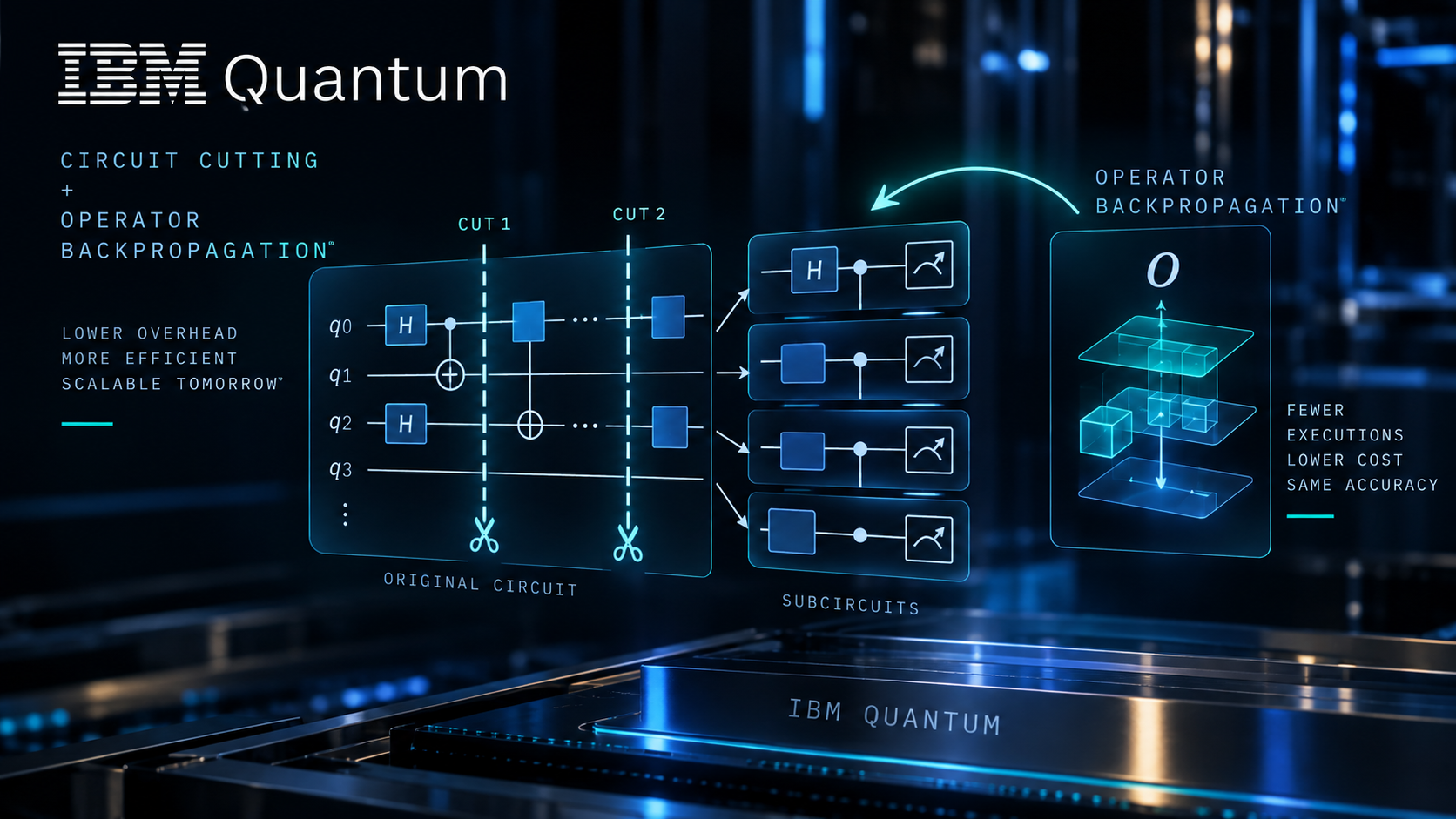
Break a large circuit into smaller independent subcircuits. This can make execution possible on smaller hardware and reduce the noise experienced by each subcircuit.
MORE CUTS → MORE EXECUTIONS
IBM QUANTUM
How operator backpropagation can be combined with circuit cutting to reduce the number of quantum circuit executions — without simply trading one source of overhead for another.
THE PROBLEM
Near-term quantum computers are limited by noise. One way to reduce the impact of that noise is circuit cutting: divide a large quantum circuit into smaller subcircuits that can be executed independently.
The smaller pieces can fit on smaller hardware and can also contain fewer gates, potentially reducing the noise accumulated during execution. The original expectation value is then reconstructed classically from the subcircuits.
The problem is that the number of required executions grows exponentially with the number of cuts.
TWO TECHNIQUES
Break a large circuit into smaller independent subcircuits. This can make execution possible on smaller hardware and reduce the noise experienced by each subcircuit.
Move part of the observable backward through the circuit classically. The hardware then executes a shallower circuit while using an updated observable.
Backpropagating through non-Clifford gates can create additional non-commuting observable terms. Those terms require additional circuit executions.
The research question is therefore not simply whether OBP helps. It is whether there is a useful point where the reduction in circuit-cutting overhead outweighs the extra executions created by backpropagation.
OPERATOR BACKPROPAGATION
Let the circuit unitary be logically divided as U = UCUQ. Instead of executing the complete circuit directly, operator backpropagation classically propagates the observable through UC.
The updated observable is Onew = UC† O UC . The hardware therefore sees the shallower UQ circuit.
Clifford gates map Pauli operators to Pauli operators, so complete backpropagation through Clifford portions does not create the same explosion of non-commuting groups.
A non-Clifford gate can transform one observable into a combination of terms. If those terms do not commute, separate quantum executions are required.
OBP therefore exposes a parameter that limits how many qubit-wise commuting groups are allowed during backpropagation.
THE COMBINED APPROACH
The central strategy is simple: reduce the depth of the circuit before asking the cutting algorithm to partition it.
The paper gives a concrete three-qubit example: vanilla cutting requires three cuts — two gate cuts and one wire cut — corresponding to 1,296 executions. After OBP, only two cuts are required, but the updated observable needs two executions. The combined method therefore requires 288 executions, about a 4× reduction.
EXPERIMENTAL RESULTS
The authors evaluated two primary circuits in detail: a 6-qubit EfficientSU2 circuit for VQE and a 19-qubit Hamiltonian simulation circuit. They also evaluated additional circuits from the Benchpress database, focusing there on execution-count reduction rather than hardware quality measurements.
The vanilla cutting approach required 432 circuit executions. Cutting equipped with OBP required 144 executions.
Similar — slightly improved — quality of outcome compared with vanilla cutting.Vanilla cutting required 1,536 executions. Cutting with OBP required 156 executions while producing a somewhat improved quality of outcome.
The experiment used a 19-qubit time-evolution circuit for a Heisenberg XYZ spin system.The paper states that these experiments were not equipped with additional error mitigation or suppression techniques. The observed improvement is therefore attributed to circuit cutting and/or OBP.
BEYOND TWO CIRCUITS
The authors applied OBP followed by circuit cutting to multiple circuits from the Benchpress database. They removed circuits with mid-circuit measurements, circuits requiring zero cuts after backpropagation, and circuits that could be completely backpropagated under the tested settings.
| Circuit | Qubits | Vanilla | Cut + OBP | Reduction |
|---|---|---|---|---|
| Fredkin | 3 | 2592 | 1152 | 2.25× |
| QAOA | 3 | 576 | 192 | 3× |
| Basis change | 3 | 2592 | 24 | 108× |
| QFT | 4 | 2304 | 144 | 16× |
| State-encoded ansatz | 11 | 12288 | 576 | 21.3× |
| KNN | 67 | 192 | 320 | ↑ overhead |
| Big adder | 118 | 108 | 84 | 1.29× |
The KNN result is particularly important. It shows why simply applying OBP is not enough: an unsuitable backpropagation parameter can actually make the method worse.
OPTIMIZING THE TRADE-OFF
The paper finds no simple relationship between max_qwc_groups and the final number of circuit executions. The best value depends on the circuit and the observable.
Rather than brute-force every possible value, the authors use simulated annealing. Their experiment used up to 20 iterations and ran five instances in parallel through Qiskit Serverless.
For the 67-qubit KNN circuit, simulated annealing found 176 executions at max_qwc_groups = 10, improving on the 192 executions required by vanilla cutting — unlike the tested small parameter range, which increased the overhead.
ANOTHER DIMENSION
The authors tested the 67-qubit KNN circuit with observables of different weights. The improvement from OBP plus simulated annealing was retained, and higher observable weights produced even fewer circuit executions in the reported experiment.
BEYOND THE MAIN METHOD
Dropping small observable terms can allow deeper backpropagation and shallower circuits, but it introduces approximation error. Once functional equivalence is lost, minimizing circuit executions alone is no longer an ideal objective.
For Hamiltonian time evolution, multi-product formulas can achieve the error of more Trotter steps using fewer steps in each circuit, at the cost of additional executions. The authors suggest that a similar optimization analysis may be useful.
Every technique that makes an individual circuit shallower can introduce another kind of execution overhead. The useful objective is the total resource cost of the complete workflow.
WHAT THIS DOES NOT CLAIM
The paper demonstrates a resource-reduction strategy for circuit cutting. It does not establish that the method provides a universal quantum speedup or that circuit cutting has become practical for arbitrary large algorithms.
The strongest experimental quality comparisons are for the 6-qubit VQE and 19-qubit Hamiltonian simulation circuits. The broader Benchpress study focuses on execution-count reduction and does not execute those benchmark circuits on hardware.
The interesting result is the optimization principle: reducing circuit depth before cutting can reduce an exponential cutting overhead, but only when the additional cost introduced by the changed observable is kept under control.
QCAASNET TAKEAWAY
Circuit cutting is powerful because it lets a large circuit be reconstructed from smaller pieces. But every cut multiplies the number of executions. Operator backpropagation attacks the other side of the problem: it makes the circuit shallower before the cutting step.
The catch is that backpropagation can create more non-commuting observable groups. The paper's contribution is therefore not simply “use OBP before cutting.” It is choose how much OBP to use for the specific circuit and observable.
Shallower circuits can be easier to execute and can require fewer cuts, reducing the cutting overhead.
A shallower circuit is not automatically cheaper. Extra observable terms can multiply the number of executions required to estimate the result.
Simulated annealing provides a practical heuristic for navigating the trade-off instead of assuming that more backpropagation is always better.
ORIGINAL RESEARCH
Debarthi Pal and Ritajit Majumdar · Quantum Information Processing, Volume 25, Article 274 (2026).
DOI: 10.1007/s11128-026-05287-x