Basis discovery
Learn which parity words are useful when the input is already represented as a suitable binary string.
IONQ
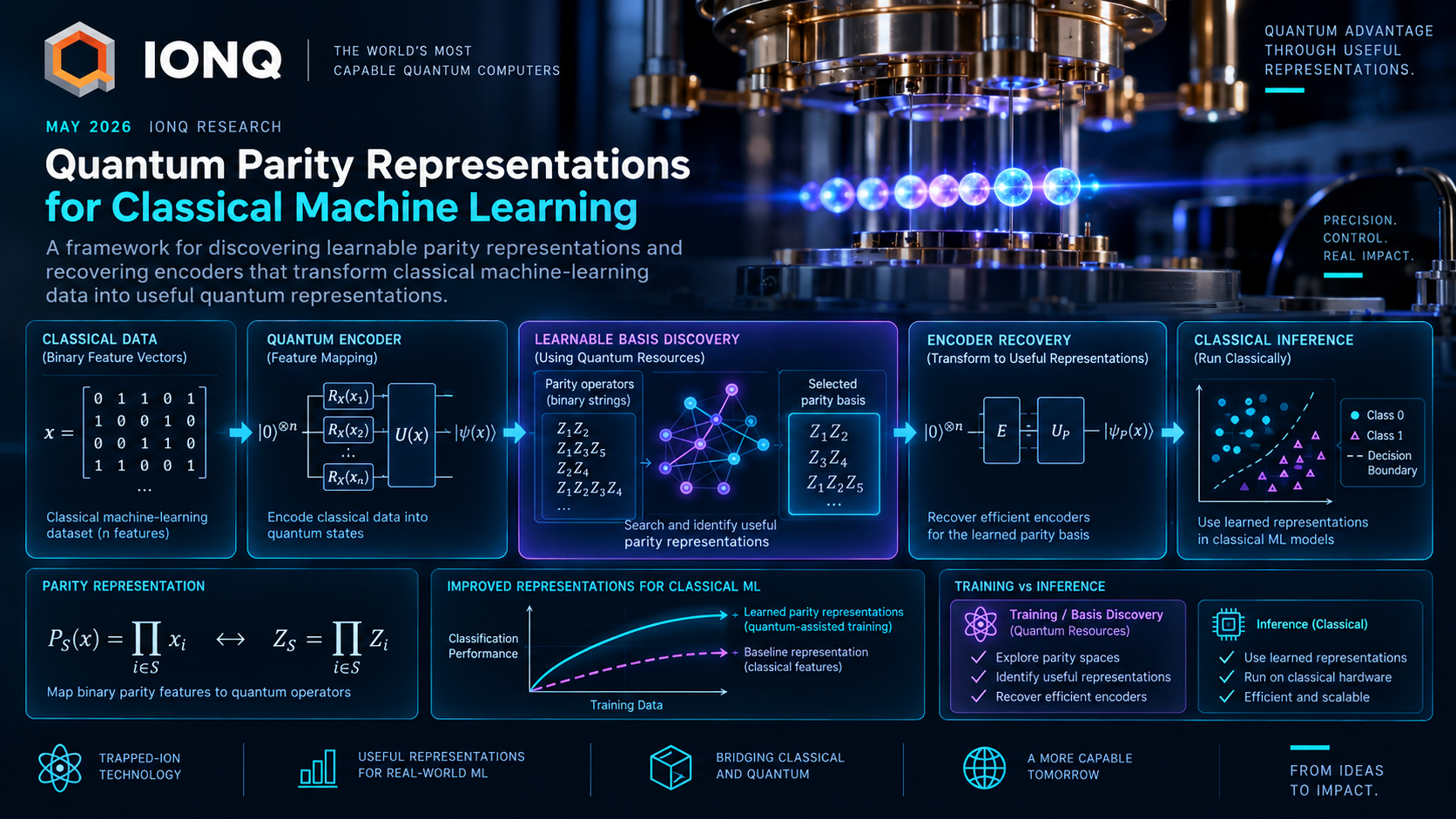
A hybrid quantum-classical approach to discovering parity-based representations for machine learning — using quantum resources during training while keeping inference classical.
THE IDEA
Machine-learning models often depend on how input data is represented. This paper studies parity features — signed products of selected binary variables — as a way to represent higher-order interactions between features.
Once the relevant binary variables and parity words are known, evaluating a parity feature requires no quantum computer. The difficult part is discovering which parity combinations contain useful information.
The researchers therefore investigate an asymmetric workflow: use hybrid quantum-classical training to discover useful representations, then perform inference entirely classically.
THE REPRESENTATION PROBLEM
If an input is already a meaningful binary string, the central problem is basis discovery: selecting useful parity words from a combinatorial search space. If the original data is continuous or not parity-ready, a second problem appears: constructing a binary representation on which parity computation is meaningful.
The paper separates these challenges and develops different mechanisms for them, making the work primarily about learning a representation that exposes higher-order structure.
Learn which parity words are useful when the input is already represented as a suitable binary string.
For continuous embeddings, learn projections that produce a more useful binary representation before parity evaluation.
Once the representation is learned, parity features can be evaluated without quantum resources.
THE QUANTUM APPROACH
For parity-ready inputs, the researchers use learnable Pauli-word selection to search for useful parity structure. The quantum component helps identify binary coefficient vectors whose corresponding parity functions are informative for the task.
For continuous data, the work studies learned projection encodings. For discrete inputs where encoding is limiting, it introduces sPQC-Parity as another route to constructing a useful binary representation.
The important architectural choice is that quantum computation is not required at the final prediction stage. The learned representation can be deployed using classical computation after training.
WHAT THEY FOUND
On three native-binary parity tasks using 5–10 qubits, the learned parity basis improved mean accuracy by 23.9% to 41.7% over the evaluated logistic-regression and support-vector baselines.
A model comparison indicates that the improvement came primarily from discovering the right parity basis rather than from quantum moment computation at inference.
Three native-binary parity problems were evaluated at 5–10 qubits.
Five continuous text benchmarks tested learned projection against dimensionality reduction and fixed binarization.
The study also examined robustness when inference is binary or quantized.
On the continuous text benchmarks, learned projection recovered much of the loss introduced by dimensionality reduction and fixed binarization, exceeding the full continuous baseline on CR, SST-2 and SST-5 in the reported experiments.
RESULTS
On three encoding-limited discrete datasets, sPQC-Parity improved over the PCA-bin baseline by 94.6% on mushroom and 3.0% on splice, while matching PCA-bin on promoter.
The study also reports exact invariance to rounding when the rounding error remains below half the quantization step, connecting the representation to constrained classical deployment.
WHY IT MATTERS
Quantum machine learning is often framed as requiring a quantum processor during prediction. This work explores a different architecture: quantum resources are used to search for hidden structure during training, while the learned structure becomes a representation that can be evaluated classically.
The practical question therefore shifts from replacing a classical inference engine to asking whether quantum-assisted discovery can produce a representation valuable enough to justify the training cost.
The quantum component targets representation discovery in a combinatorial search space.
Once parity words and encodings are fixed, feature evaluation does not require a QPU.
The quantum contribution can be concentrated in model development rather than every prediction.
THE TRADE-OFF
The paper demonstrates improvements on selected datasets, but discovering a useful parity basis remains difficult because the number of possible binary coefficient vectors grows rapidly with the number of input variables.
The experiments do not establish a universal replacement for conventional machine learning. They show settings in which hybrid quantum training uncovered parity structure that the evaluated classical baselines did not capture as effectively.
The quantum resource is part of the representation-learning pipeline, not a requirement for every individual prediction.
APPLICATIONS
Tasks where labels depend on higher-order interactions between binary variables are a natural setting for parity features.
Learned projection encodings provide a route for applying parity representations to continuous embeddings.
Classical parity evaluation can fit deployment environments where inference must be inexpensive.
The reported robustness analysis connects parity representations with binary and quantized inference.
The work is an example of quantum computation being used during model development while deployment remains classical.
The study treats feature representation itself as an object that quantum resources may help discover.
QCAASNET TAKEAWAY
The central idea is that quantum computing does not necessarily need to be present when the model is making predictions. It can instead be used to discover a representation that is difficult to find with straightforward classical search.
Parity features can express higher-order interactions while remaining cheap to evaluate once useful parity words are known. The reported experiments show meaningful gains on selected binary and encoding-limited datasets.
The work focuses on discovering a useful feature basis rather than replacing inference with a quantum circuit.
Hybrid quantum-classical optimization searches for useful parity structure and encodings.
After learning, inference can be performed entirely with classical computation.
The broader lesson is a different way to think about quantum machine-learning workflows: a quantum contribution could be concentrated in the discovery stage and then reused across many classical inferences.
The next question is whether training cost, scaling behavior and hardware requirements can produce an end-to-end advantage on larger, independently selected real-world workloads. The reported experiments are evidence for the studied tasks, not a universal demonstration of quantum advantage in machine learning.
ORIGINAL RESEARCH
Quantum Parity Representations: Learnable Basis Discovery, Encoders, and Shadow Deployment by Sang Hyub Kim, Oliver Knitter, Jonathan Mei, Claudio Girotto, Masako Yamada, Martin Roetteler and Chi Chen.