The underlying problem
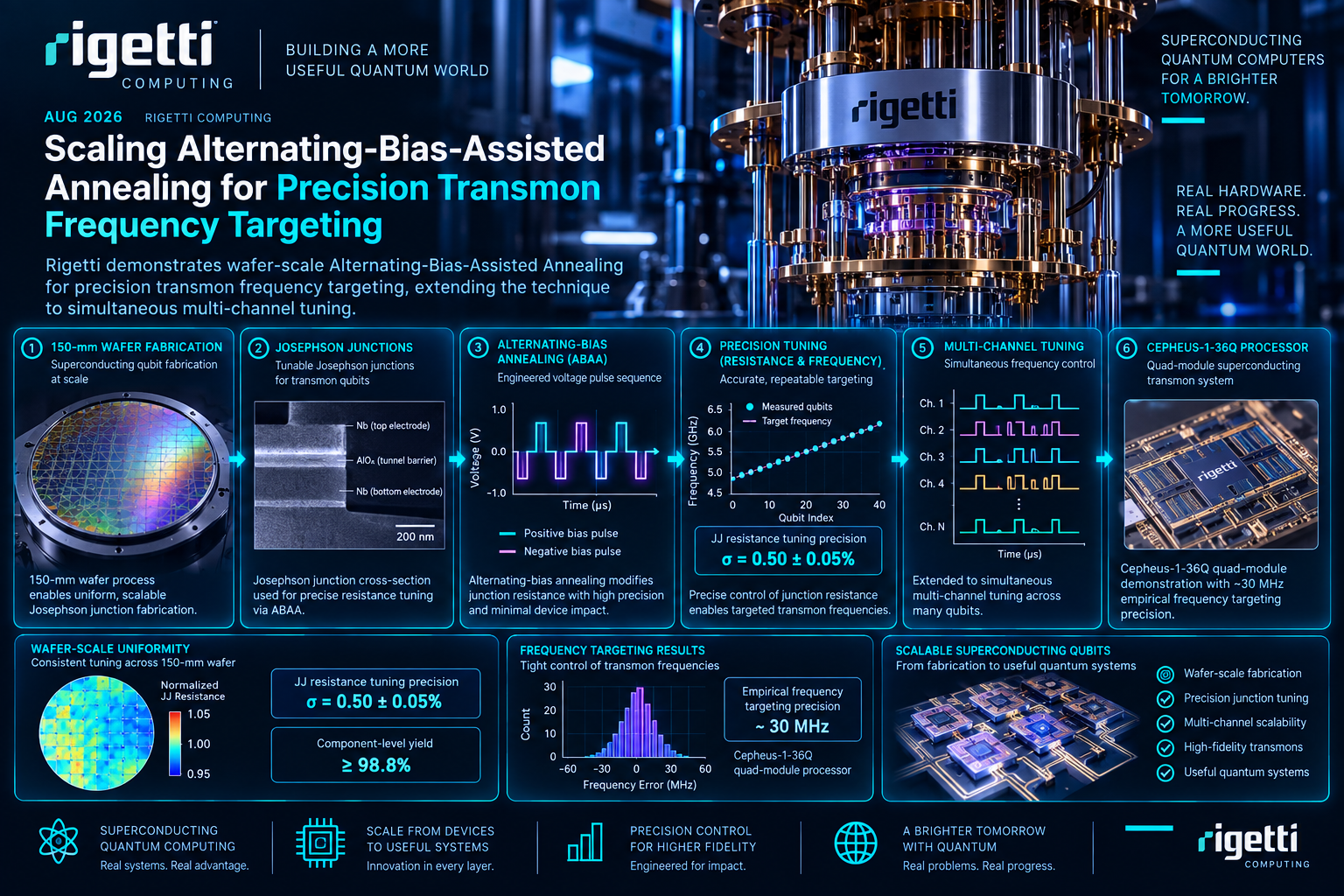
The work evaluates alternating-bias-assisted annealing for precision Josephson-junction resistance tuning and extends the technique to simultaneous multi-channel tuning.
RIGETTI COMPUTING
The work evaluates alternating-bias-assisted annealing for precision Josephson-junction resistance tuning and extends the technique to simultaneous multi-channel tuning.
THE IDEA
The work evaluates alternating-bias-assisted annealing for precision Josephson-junction resistance tuning and extends the technique to simultaneous multi-channel tuning.
The research sits within a broader quantum-computing challenge: improving the connection between algorithms, hardware, control, error correction and useful applications. The specific contribution depends on the structure of the work and the assumptions under which its results are obtained.
Rather than treating the result as a standalone headline, the important question is what technical bottleneck the researchers addressed and what capability their method adds to the quantum computing stack.
WHY IT MATTERS
Quantum systems are constrained by finite coherence, imperfect operations, limited measurement resources and the overhead required to control or correct errors. Research in this area therefore often improves one layer while preserving compatibility with the layers around it.
The work evaluates alternating-bias-assisted annealing for precision Josephson-junction resistance tuning and extends the technique to simultaneous multi-channel tuning.
The work introduces or evaluates a technical approach aimed at reducing the relevant computational, hardware or algorithmic bottleneck.
Its significance depends on how the method interacts with the rest of the quantum-computing workflow, including implementation and scaling requirements.
THE APPROACH
The researchers build the result around the central technical object identified by the paper. In practical terms, the method connects the problem formulation to a quantum circuit, hardware experiment, compiler workflow or hybrid computational procedure.
Establish the computational or hardware objective and the constraints that determine whether a solution is useful.
Apply the paper's algorithmic, physical or systems-level construction to the target problem.
Compare the resulting behavior using the metrics and experimental or theoretical conditions reported by the work.
This distinction matters because a research result can be theoretically efficient, experimentally demonstrated, or primarily architectural. Those categories should not be treated as equivalent.
RESULTS
The reported result is specific to the assumptions, hardware, datasets, simulations or benchmark problems used in the study. The work should therefore be read as evidence for the stated technical claim rather than as a blanket statement about quantum computing performance.
The paper reports quantitative or qualitative evidence for the proposed method under its stated evaluation conditions.
The practical cost depends on circuit depth, qubit count, measurements, classical computation, control electronics or other resources relevant to the research.
A research demonstration or theoretical improvement does not automatically establish practical quantum advantage against the best classical alternative.
WHERE IT COULD MATTER
The most relevant applications follow from the technical problem addressed by the research. The work may contribute to hardware scaling, fault-tolerant computation, quantum algorithms, simulation, optimization or hybrid quantum-classical workflows.
The research contributes to this area by addressing a concrete technical bottleneck identified in the work.
Improvements in this layer can influence the efficiency, reliability or scalability of larger quantum workflows.
The longer-term relevance depends on integration with hardware, software and control systems at realistic scale.
These should be treated as potential directions unless the original work demonstrates a complete application end to end.
QCAASNET TAKEAWAY
The central contribution is the technical method reported by the researchers, not a generalized claim that quantum computing has already solved the broader problem.
The work evaluates alternating-bias-assisted annealing for precision Josephson-junction resistance tuning and extends the technique to simultaneous multi-channel tuning.
The research adds a specific method, architecture, algorithm or experimental result to the quantum-computing toolbox.
Moving from a research demonstration to a useful system requires the underlying method to remain effective as problem size and system complexity increase.
Practical value depends on complete end-to-end workflows, realistic resource costs and comparison with strong classical alternatives.
The useful way to read this work is to separate the demonstrated result from the future capability it may enable. That distinction keeps the research technically interesting without overstating what has already been achieved.
ORIGINAL RESEARCH
Scaling Alternating-Bias-Assisted Annealing for Precision Transmon Frequency Targeting on Superconducting Quantum Processors